“The only man who sticks closer to you in adversity than a friend is a creditor.” (Evan Esar)
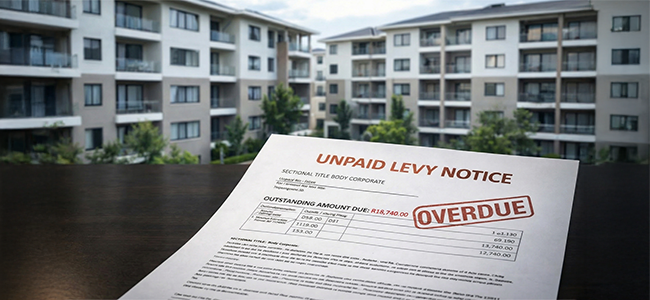
Body corporates face a familiar problem. Owners fall into arrears. Levies go unpaid. Legal costs mount. The temptation is to reach for the most forceful remedy available.
Sequestration may seem like that remedy. If an owner will not pay, why not have them declared insolvent?
A recent Gauteng High Court judgment offers a clear warning. A body corporate sought the sequestration of a unit owner for levy arrears exceeding R1.4 million. With such a substantial debt, the body corporate’s frustration was understandable. But the application failed.
The court held that the body corporate had not met the statutory requirements under the Insolvency Act. In particular, it had not shown that sequestration would be to the advantage of creditors. The court also noted that the body corporate had other execution remedies available and emphasised that sequestration proceedings are not intended to function as a debt-collection mechanism.
What is sequestration?
Sequestration is a court-ordered insolvency process under the Insolvency Act. It applies where a debtor can no longer meet their financial obligations. The court places the debtor’s estate under the control of a trustee, who sells the debtor’s assets and distributes the proceeds among creditors.
The test for sequestration
To succeed, the applicant must establish three things:
- The debtor has committed an act of insolvency, or is actually insolvent.
- There is reason to believe sequestration will be to the advantage of creditors.
- The applicant has a liquidated claim against the debtor.
The second requirement is where many applications come unstuck.
Where sequestration applications unravel
Sequestration is not designed to punish debtors or pressure them into payment. It’s a collective remedy, intended to ensure the orderly distribution of a debtor’s assets among all creditors.
The applicant must prove that there’s a good chance that creditors will receive a meaningful dividend. If the debtor has no realisable assets, or if the costs of sequestration would consume whatever value exists, the application will fail. The court will not grant sequestration simply because a debt is owed.
Sequestration is not leverage
In practice, some creditors use sequestration applications as a form of pressure. Their reasoning is simple: the threat of insolvency may prompt the debtor to settle. But our courts have made clear that this is not appropriate.
In this case, the court emphasised that insolvency proceedings are not a private debt-collection mechanism. They carry serious consequences: loss of control over assets, restrictions on legal capacity, and reputational harm. These consequences are justified only where the statutory purpose is served.
Where the true aim is to recover a debt rather than administer an insolvent estate, the court will refuse the application.
What body corporates should consider
Before pursuing sequestration, a body corporate should ask practical questions.
- Does the owner have realisable assets? If the only asset is the unit itself, and it is bonded, there may be little left after the bondholder is paid.
- Would the costs of sequestration exceed the likely recovery?
- Has the body corporate exhausted more conventional remedies? A judgment, followed by execution against property, may be more direct and effective.
If the answers suggest that sequestration will not benefit creditors, the application is unlikely to succeed.
Other options
Body corporates have several remedies for levy recovery: obtaining a judgment and executing against the property, applying for an attachment of emoluments, or seeking a sale in execution.
Each has its own requirements, but they are all designed for debt recovery (unlike sequestration).
Where this leaves body corporates
Sequestration is a remedy of last resort, not a debt-collection tool. The Insolvency Act sets strict requirements, and courts will hold applicants to them. If you are unsure which remedy is appropriate, we can help.
Disclaimer: The information provided herein should not be used or relied on as professional advice. No liability can be accepted for any errors or omissions nor for any loss or damage arising from reliance upon any information herein. Always contact us for specific and detailed advice.
© LawDotNews